Beyond Keywords: How to Optimize Your Brand for AI Agent Recommendations in 2026
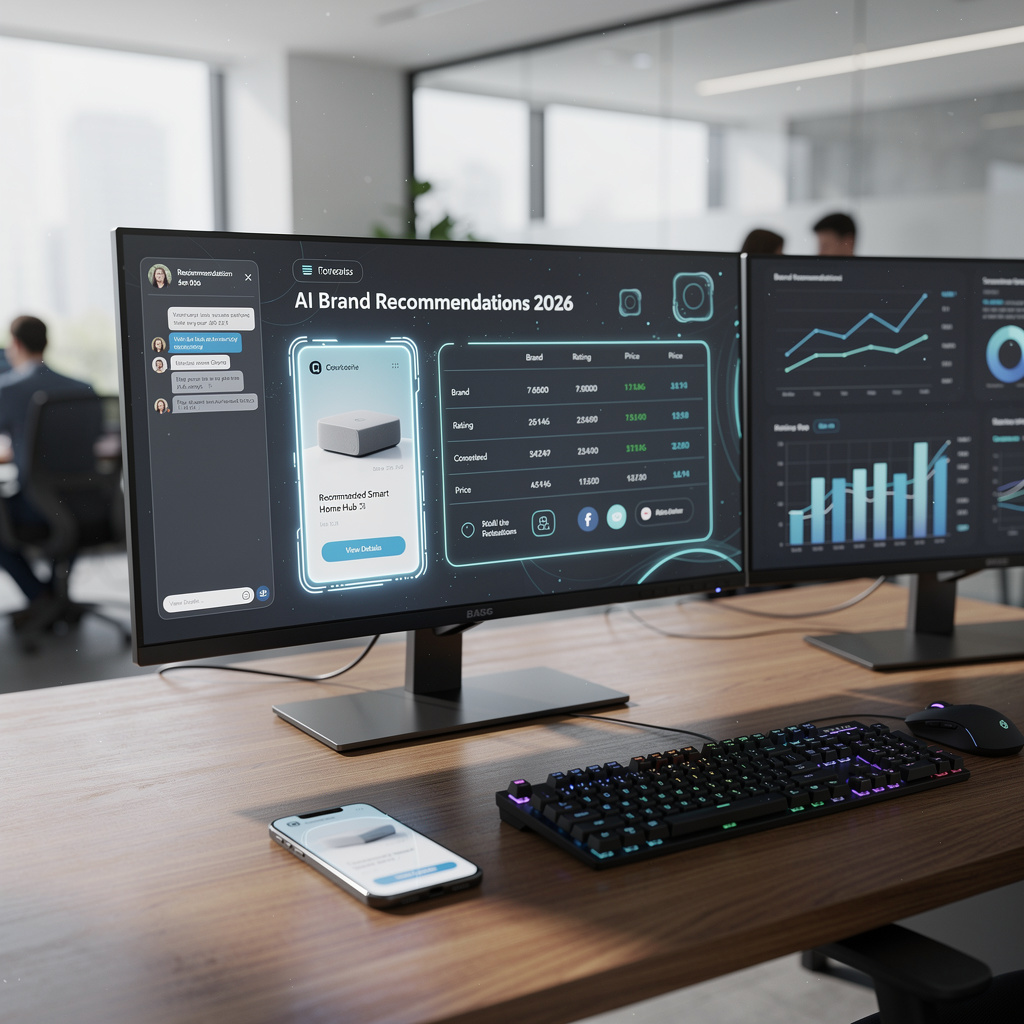
As consumers shift from traditional search queries to conversational AI agents, businesses must adapt their SEO strategies. Learn how to optimize your brand's digital footprint so LLMs and autonomous agents recommend your products first.
Beyond Keywords: How to Optimize Your Brand for AI Agent Recommendations
The landscape of search has fundamentally cracked open. For decades, digital marketing relied on a predictable loop: a human typed a query into a search bar, scanned a list of blue links, clicked a website, and made a decision. Today, that loop is increasingly obsolete.
We have entered the era of autonomous AI agents. Consumers and procurement officers no longer just use search engines; they dispatch personalized, multi-modal AI agents to find, compare, negotiate with, and purchase products on their behalf. If your brand isn't visible to these machine decision-makers inside their context windows, you are effectively invisible to the market.
Transitioning from traditional Search Engine Optimization (SEO) to Generative Engine Optimization (GEO) and Agentic Engine Optimization (AEO) requires a fundamental mindset shift. You are no longer optimizing for human eyeballs reading a SERP; you are optimizing for Large Language Models (LLMs) and autonomous agents evaluating your brand's digital footprint.
The Anatomy of an AI Agent's Decision
To optimize for AI agents, you must first understand how they formulate recommendations. Unlike traditional search crawlers that rank pages based on backlink profiles and keyword density, AI agents use complex pipelines consisting of:
- Pre-trained Knowledge Bases: The core weights of the foundational models (such as GPT-5, Claude 4 Portfolio, or open-weight alternatives) trained on massive web crawls.
- Retrieval-Augmented Generation (RAG): Real-time web-scraping and API queries executed when the agent needs up-to-the-minute data.
- Knowledge Graphs and Entity Relationships: Highly structured databases that map how your brand connects to other concepts, competitors, and reviews.
- Synthetic Reasoning Chains: The internal logical steps the agent takes to evaluate trade-offs (e.g., "Which CRM offers the best security-to-price ratio for a 50-person remote team?").
When an agent is tasked with finding a solution, it synthesizes these inputs. If your brand is mentioned across trusted datasets but lacks structured, verifiable APIs or schema, the agent will skip you in favor of a competitor whose data is easier to parse and verify.
Core Pillars of Agentic Engine Optimization (AEO)
1. Optimize for LLM Citations and RAG Pipelines
To win the recommendation, your content must be easy for an LLM to retrieve, summarize, and cite. This means moving away from gated, convoluted PDFs and dynamic, JavaScript-heavy single-page applications that slow down agentic browsers.
- Implement LLM-Friendly Formatting: Structure your high-value pages with clear markdown-style headers, summarized key-takeaway boxes, and bullet points. Agents love bulleted summaries because they fit neatly into limited context windows without requiring high token consumption.
- Establish an
/ai-agents.txtFile: Much likerobots.txtdirected search crawlers, brands are now deployingai-agents.txtorllm-robots.txtfiles. These files explicitly point agents to your structured product catalog, current pricing APIs, and brand FAQs, ensuring they pull accurate, real-time facts rather than hallucinated or outdated pricing.
2. Entity Mapping and Semantic Richness
AI agents rely heavily on entity resolution. They need to know exactly what your brand is, who is associated with it, and which market category you occupy. This is achieved through advanced structured data.
- Build a Strong Schema Profile (JSON-LD 2.5+): Don't settle for basic organization schema. Implement highly nested JSON-LD that defines your product capabilities, executive entities, pricing models, and direct competitors. Define your relationships explicitly so the LLM's internal knowledge graph links your brand to high-value industry terms.
- Own Your Knowledge Graph Footprint: Ensure your brand is accurately represented in decentralized data nodes like Wikidata, DBpedia, and niche industry directories. If an agent cross-references your website claims with Wikidata and finds a discrepancy, its trust score for your brand drops.
3. Cultivate "Synthetic Word-of-Mouth"
LLMs are trained extensively on public forums, developer communities, and social media. When an agent is asked, "What is the most reliable email marketing tool for e-commerce?" it doesn't just look at your homepage; it analyzes sentiment patterns across Reddit, Discord, Substack, and GitHub.
- Decentralized Sentiment Management: Encourage genuine discussions about your product on third-party platforms. Brand mentions in natural, conversational contexts carry far more weight in an LLM's training dataset and real-time RAG searches than pristine, corporate press releases.
- The Co-occurrence Factor: Ensure your brand name frequently co-occurs in text alongside your target category and high-sentiment keywords. If "Brand X" is repeatedly mentioned in the same paragraph as "easy integration" and "reliable uptime" across thousands of forum posts, the LLM naturally associates those positive attributes with your entity.
Actionable Checklist: Preparing Your Brand for the Agentic Era
To ensure your brand is positioned to capture agentic recommendations, execute the following technical and strategic playbook:
- Deploy Agent-Readable APIs: Build lightweight, public-facing read APIs that allow agents to query your stock, pricing, and compatibility matrices instantly. An agent is highly likely to recommend a product it can instantly confirm is in stock.
- Audit Your Brand for "Hallucination Vulnerabilities": Search for your brand using leading conversational models. Identify where they hallucinate information about your services, and trace where that misinformation originates (e.g., outdated press releases, abandoned subdomains) to clean up your digital footprint.
- Create Structured Comparison Hubs: Rather than hiding from competitor comparisons, publish objective, structured comparison pages on your site. Use clean tables, direct feature-by-feature breakdowns, and schema markup. Agents appreciate unbiased formatting and will often pull directly from your tables to present options to their users.
- Incentivize Semantic Reviews: When asking clients for reviews, guide them to be highly specific. Instead of "Great service!", prompt them to write, "Brand Y solved our automated billing bottlenecks and saved us 15 hours a week." This semantic detail provides the rich contextual data LLMs look for during retrieval.
Real-World Scenario: The Agentic Buyer in Action
Imagine a procurement officer directing their autonomous agent: "Find a SOC2-compliant cloud database tool that integrates with our current tech stack, has a latency under 10ms, and fits within our monthly budget of $5,000. Negotiate a demo if possible."
The agent doesn't search Google. It queries an LLM-driven search interface, parses the API documentation of several providers, reads developer sentiment on Reddit, and verifies SOC2 compliance certificates via public registries.
If your website relies on flashy graphics but hides latency data behind a "Book a Call" wall, the agent cannot extract the necessary metrics. It cannot verify your compliance. It cannot confirm your pricing. Consequently, your brand is filtered out in the first millisecond of the agent's synthesis. The competitor with open, structured, and machine-readable data wins the opportunity without a human ever knowing you existed.
The Future of AEO: Looking Forward
As we look toward the horizon, the separation between human-optimized content and machine-optimized data will continue to widen. The brands that dominate the next decade will be those that treat machines as a core audience. By structuring your data elegantly, maintaining an impeccable and verified digital reputation across the web, and making your assets infinitely readable to LLM scrapers, you ensure that when the world's AI agents are sent out to shop, they return with your brand.
Ready to Scale Your Brand?
Our team of experts can help you implement these insights and drive real results.